Breaking the Gemini Barrier: What Happens to Journalism Without Search Results
AI answers are becoming the default interface to information. In three ordinary searches, I got what I needed from Gemini and almost never reached journalism. That gap is the Gemini barrier: when answers satisfy intent before reporting is discovered. The question is not whether journalists should write, but how they should publish so that answers still lead to them.

Oddly, I’m often asked how I would plan a journalistic production and delivery pipeline if I were starting from scratch today.
The odd part is that the question is disingenuous, at least as far as the “scratch” part is concerned. Usually there’s a newsroom in the picture; there’s a brand, new or old, existing or purely imagined; usually a domain has been purchased; usually there’s a managing editor galloping on the sidelines with strong opinions about artificial intelligence and Oxford commas. There’s a public, an editorial line. A business model. An angel investor, or the idea of one, if we get to convince them to jump on board. One out of two, there’s a WordPress to resuscitate, ripe with malware, non-async jQuery, and long tails of shortcodes.
Not that these are not fun and interesting scenarios; they absolutely are. But “from scratch,” to me, means from scratch. Clean slate. No strings attached. In vitro journalism. So, since I usually keep the true answer to myself, I am going to try to give it here.
When I need a place to start, I usually end up thinking about what users would want. And since I don’t know the answer to that question, I look at myself as a user and check what questions I have asked recently. So here they are, no lies or omissions, my last three Google searches:
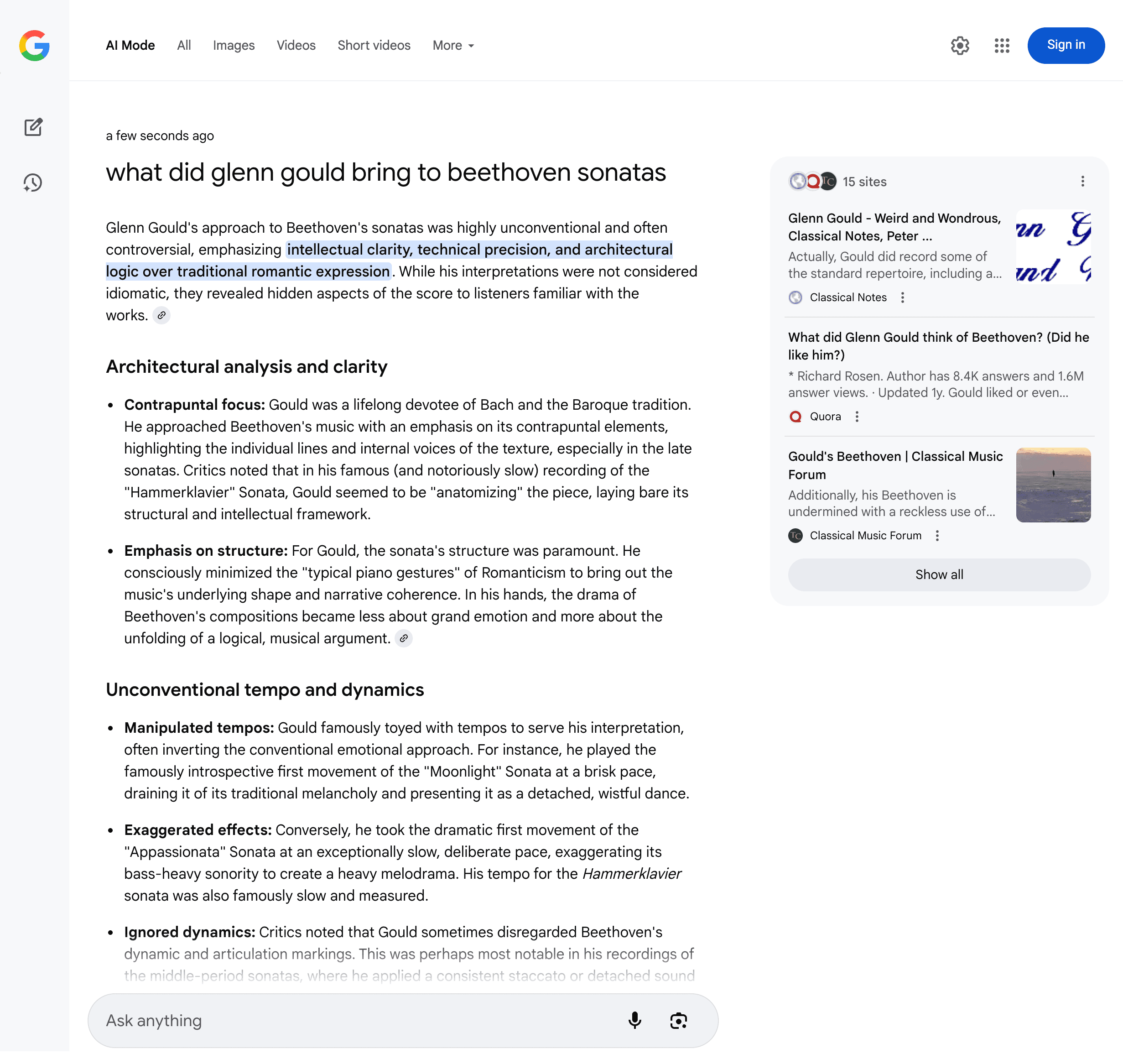
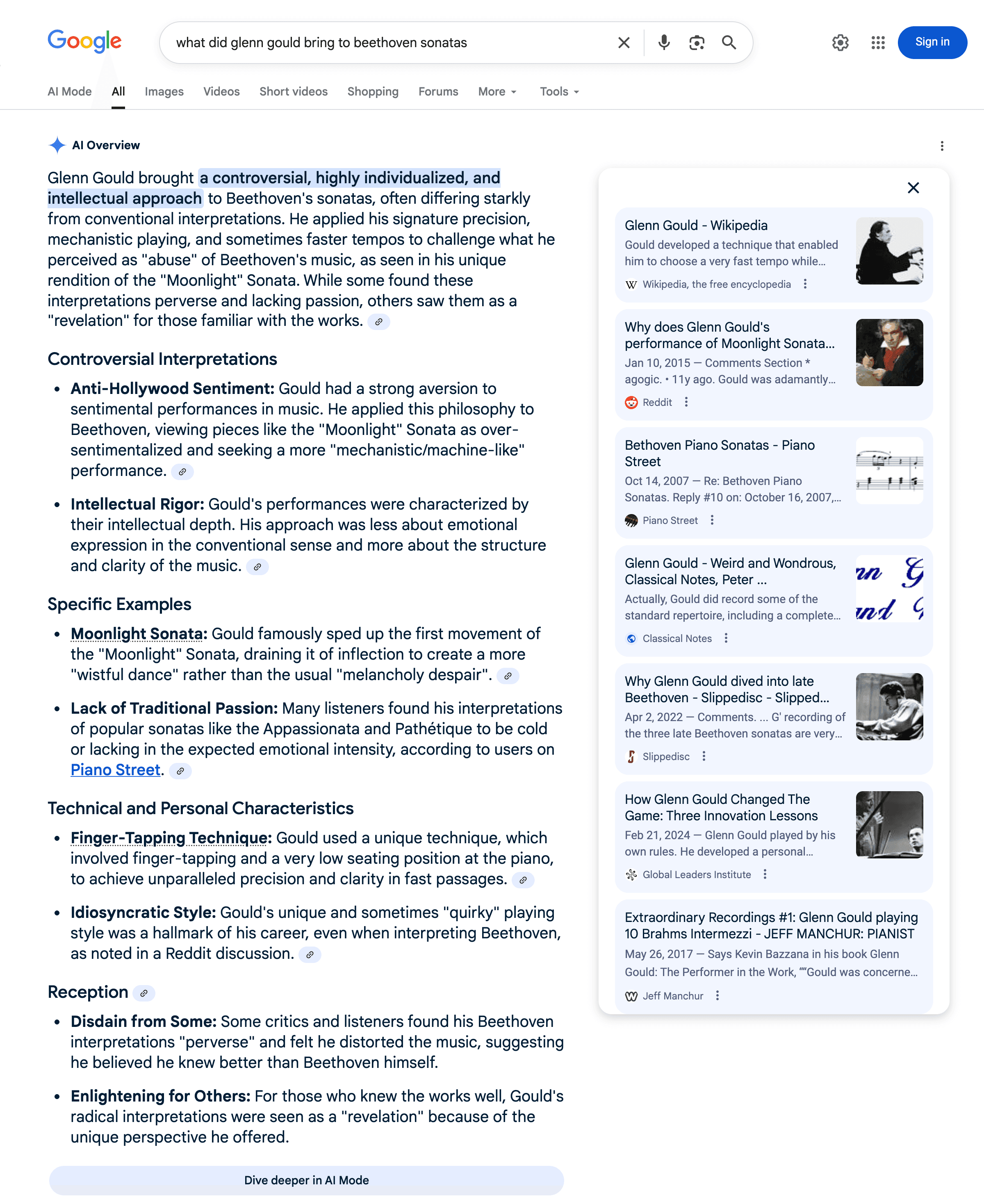
- “What did Glenn Gould bring to Beethoven’s sonatas?”
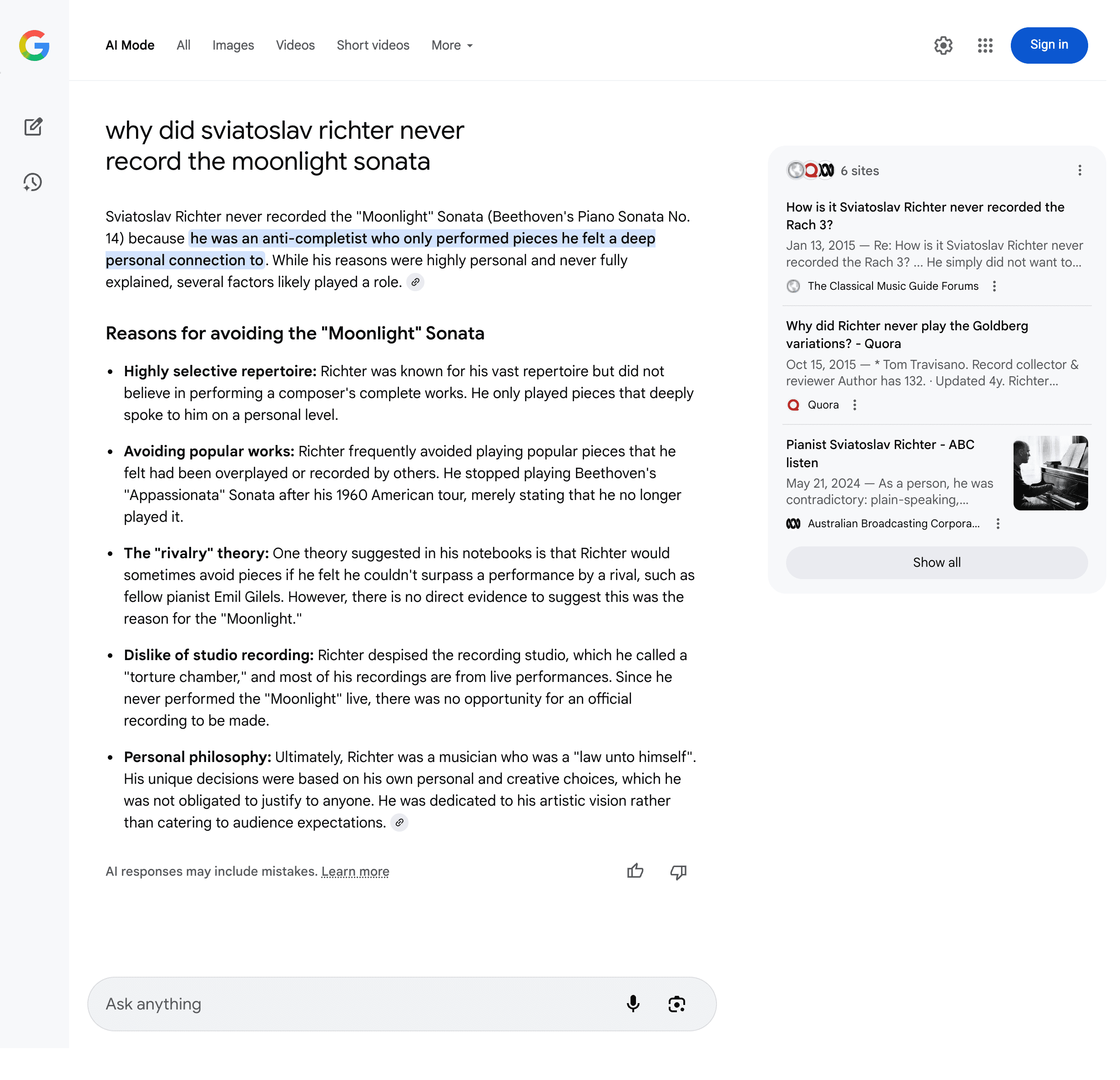
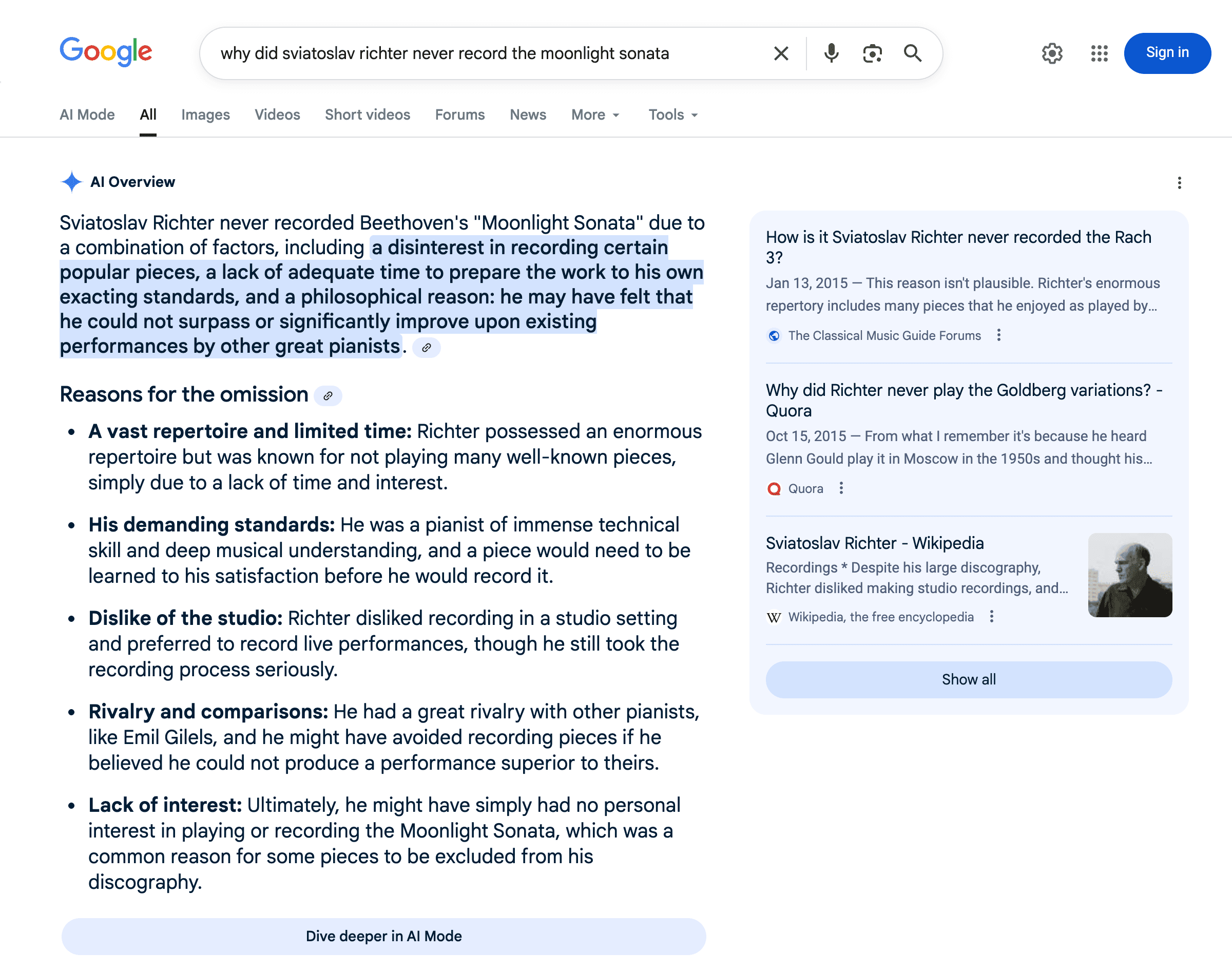
- “Why did Sviatoslav Richter never record Sonata No. 14?”
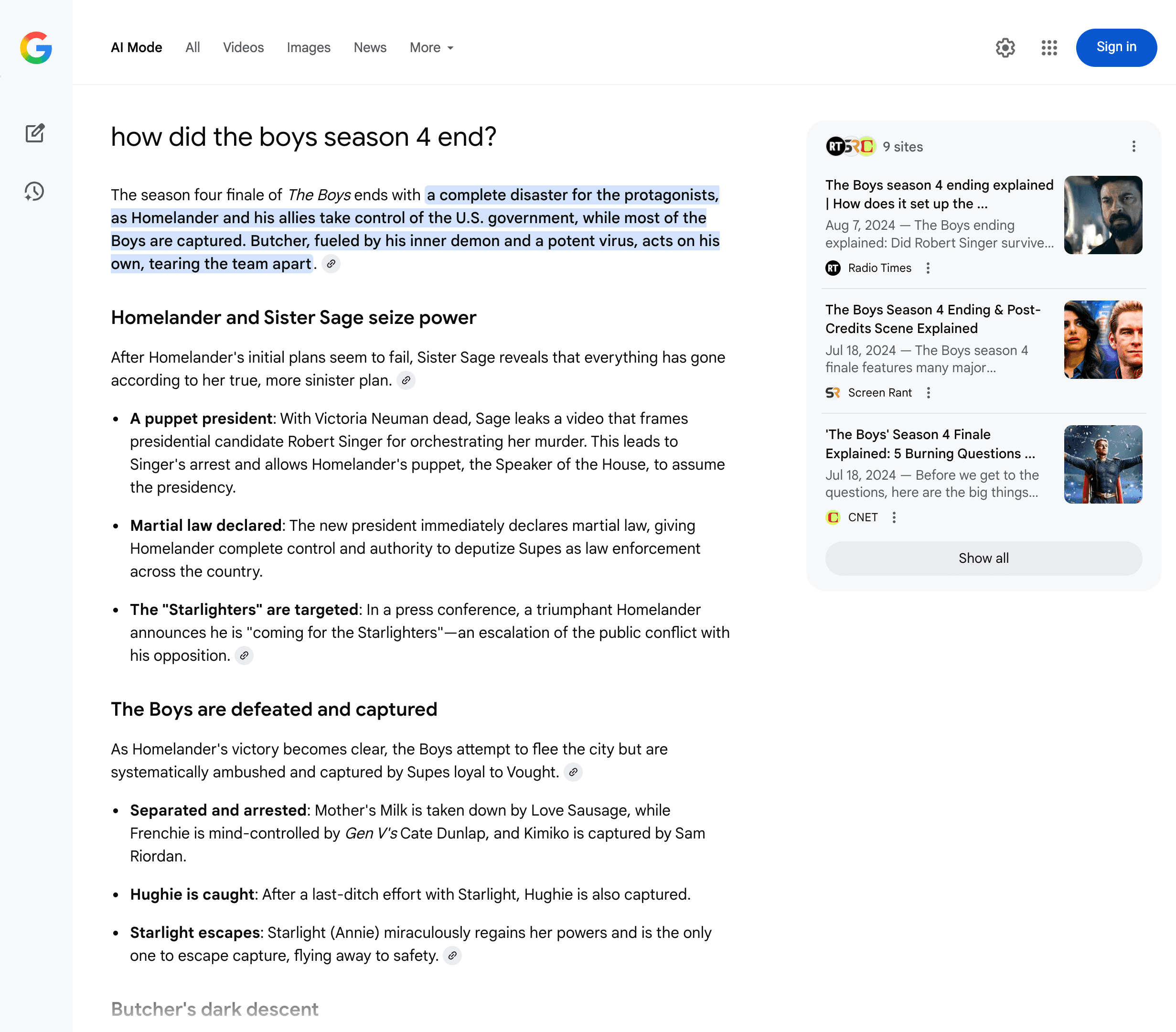
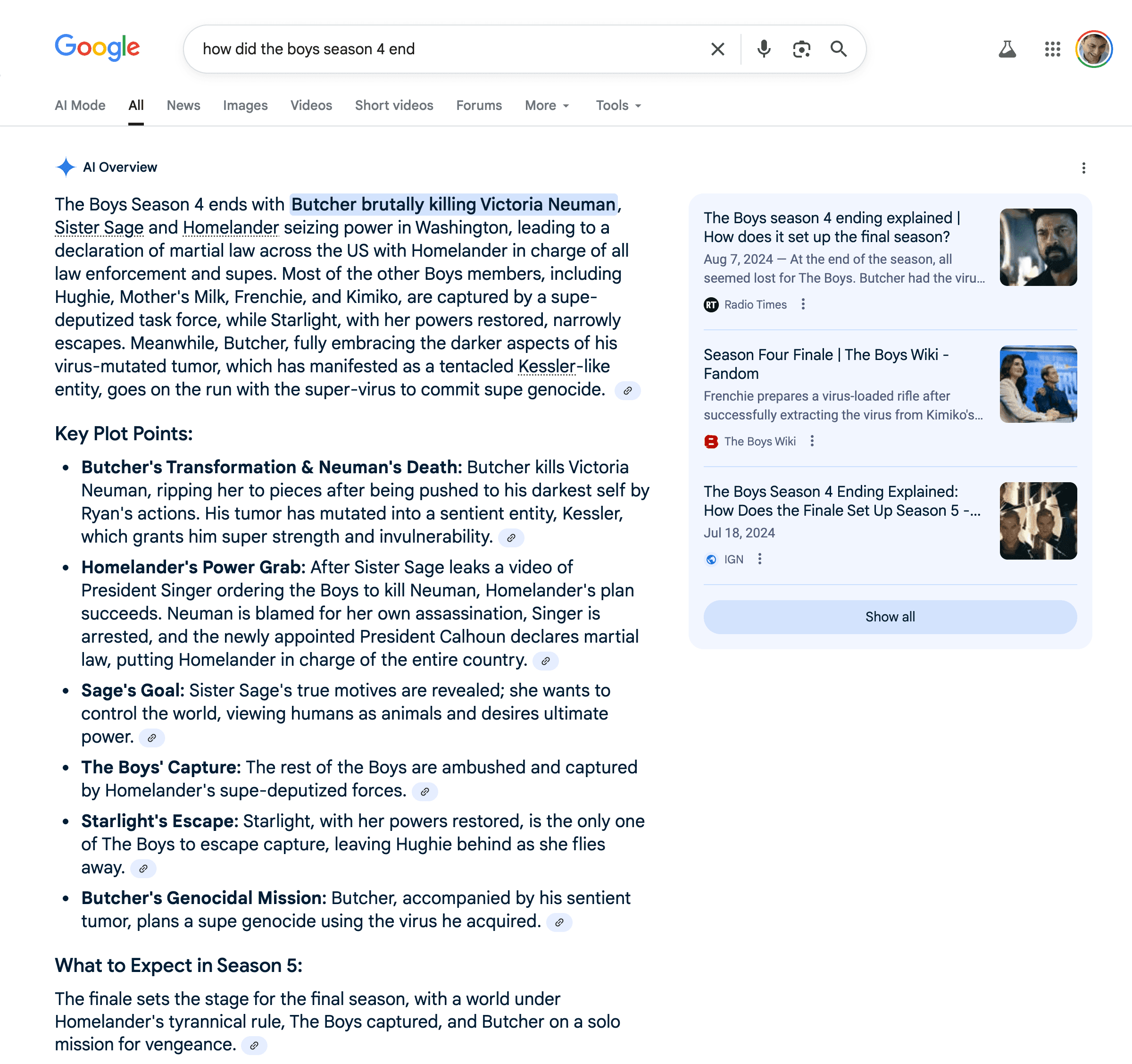
- “How did The Boys season four end?”
Hardly breaking news, you will say. True. But breaking news is not the thing that most often interests users; it’s mostly us journalists who give breaking news thought and importance. Users are more interested in context and background. So in a way, Beethoven and Homelander will do just fine for this exercise.
Brief note on method. I ran the same queries with Search Labs active in New York City, comparing classic results to “AI mode,” on desktop and mobile. I noted whether sources were listed and where my next clicks went.
Glenn
Not every search result is created equal, of course. My browser has AI mode active, and in New York City, where I live, the guidelines for search engines are less strict than in some other countries, especially in the European Union. This is the reason why I never even see the traditional search results, sponsored or ranked, and it’s Gemini that gives a response to my questions.
Gemini does so with a mouthful, telling me straight away that Gould “brought a controversial, highly individualized, intellectual approach to Beethoven’s sonatas.” Ouch. It’s clear that “intellectual” is used with a low-key negative connotation. Were this not incognito mode, Gemini might take into account that Gould is very important to me and watch its language.
My eyes first roll, then scan the response enough to understand that it is informative and unoriginal, something I have heard a million times before. I realize that what I really wanted to ask was: “Is there a book of Gould’s letters, interviews, or whatever in which he himself talks at length about the crazy and extraordinary tempo he chooses for Sonata No. 23?” Needless to say, I couldn’t care less about lore or tales of Gould’s eccentricities; I’m after philology: specifically how altering pacing exposes sectional design and surfaces form in Beethoven. (By the way, the 2-part interview with Humphrey Burton on Beethoven more than covers this.)
It never even crosses my mind to tap most of the sources listed in the right sidebar to find a better answer, but I do quickly peek into a Reddit thread on Gould and Beethoven. My next stops are Spotify to replay the sonata’s third movement one more time and then straight to Amazon, where I find a discounted Kindle edition of Chemins de traverse, a collection of Gould’s essays edited by Bruno Monsaingeon.
On desktop, the vanilla result and AI mode look similar in their source lists (perhaps AI mode surfaces a few more niche sources). On mobile, there are no sources at all. It is just Gemini.
Takeaway: Gemini satisfied the top of my intent until I, unprompted, routed the transaction to Amazon. Journalism never entered the path.
It’s a lost opportunity. I’m a legit user with purchase intent, yet I never reach classical music magazines that might sell me a subscription or surface in-depth pieces on Gould and Beethoven. It is me, Google, then the Kindle store, with a single detour to a Reddit thread from May 11, 2008.
Sviatoslav
I land on the Richter query after rage-clicking out of Spotify, where older classical recordings are elusive. Gemini confirms my hunch: Sviatoslav Richter, perhaps the most amazing Beethoven interpreter of the twentieth century, never recorded either the Moonlight Sonata or the Waldstein.
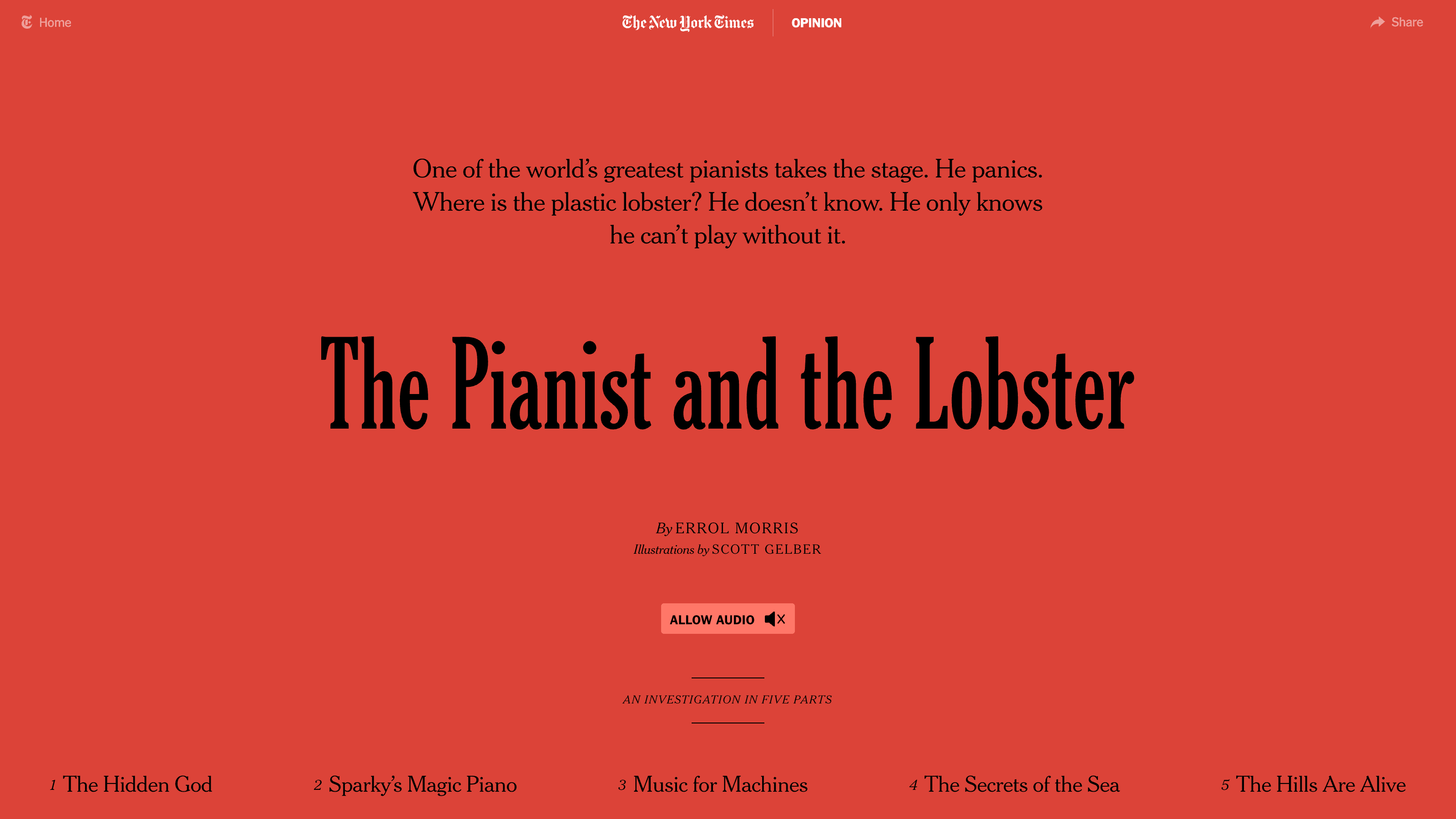
Again, vanilla and AI mode sources align. Again, I click only Reddit. From there I finally discover what I was actually after, without knowing it existed: Errol Morris’s five-part investigation, “The Pianist and the Lobster,” a monster article published in 2019 by The New York Times.
It includes, among other things, Gould telling Monsaingeon that he wished to have Richter in his studio and be his record producer. “I’m damned serious. He could play whatever repertory he liked, even Rachmaninoff, on my own piano if he wanted."
Once again, I am a user with intent. I spend half an hour on YouTube, chasing as many recordings of Richter playing Beethoven’s sonatas as I can, then read the New York Times piece end to end. Did Gemini take me there? No, it did not.
Takeaway: High-value journalism was the closest answer to my question, but I found it indirectly through Reddit, not through search.
Homelander
For symmetry, my pop culture query. I had binged Gen V and wanted a quick catch-up on The Boys season four. Gemini’s first paragraph tells me everything I wanted to know. Sidebar sources include CNET and Screen Rant (big mastheads, I notice, rarely appear). AI mode is largely identical, and on mobile I see no sources.
Takeaway: For quick, shallow intent, AI mode is more than enough. Journalism is optional.
Let’s draw a few editorial notes.
- If it were not for Reddit, my entire morning would have been confined to automated journalism. By that I mean AI-assembled answers that synthesize existing sources and present a direct response to a user’s question. That is what Gemini does, no?
- My companions were platforms ready to monetize my interest with 1-click checkout buttons and infinite scroll: Spotify, YouTube, Amazon. The one gem of the morning was an astounding piece of journalism, but search did not guide me to it.
- If users get in the habit of receiving pre-digested and hyper-precise answers from a bot, in quick-access chunks with the most important tidbit highlighted, why should they bother to read media outlets where information is presented in an impersonal, standardized format—in an order, tone, and language in no way attuned to their immediate interest—perhaps intertwined with flashy ads and pop-ups, hidden behind paywalls, under a cascade of breaking news they did not ask for or care about?
- The unit of value starts looking less like an article with a byline and more like a product component, closer to Febreze air freshener, where the “authors” are unnamed talented chemists, researchers in perfume anthropology, and cunning patent attorneys. Something like Adobe Photoshop or a Canon R6 Mark II, where the human makers are present yet invisible. Video and audio productions are almost there already.
Which brings me to ask a few questions:
- How can I make sure that my content still reaches users two years from now? How do I break through the Gemini barrier?
- If journalists are still responsible for gathering and presenting information users need, why would they make it available to Gemini to steal their thunder?
- Is it even possible to break the Gemini barrier? Is search a viable strategy anymore? Why would publishers even consider allowing Google to crawl their content — why don’t they come together as a consortium and make their own search engine of only journalistic content? [Idealist, naive or foolish? Pick my poison.]
I don’t have precise answers, but I know that old-fashioned journalism has very little room to breathe in this environment. Information must adapt to its marketplace. Structured news is what we must feed automated systems if we want them to answer precisely. Interfaces will look more like chat and less like front pages. With enough personalization, after all, the front page disappears.
So, back to the original question, how would I imagine an editorial pipeline if I were to do it from scratch?
First, I would think that I need an editorial system that does not archive content as articles with unique IDs but as information atoms connected to entities (organizations, people, places) and to one another. Content should be liquid across time and format, ready to assemble on demand. Context and background must propagate wherever needed, in a register that fits the situation and the user’s voice. Human reporting remains essential, but the volume of questions will require generated text to carry much of the load.
Authorship would still be human, just human in a different way. The work of one reporter will flow into the work of dozens of others.
[And yes, I believe there can still be beauty in the Febreze era of journalism. You can still have your “Pianist and the Lobster” stories, or simpler features (not in five parts) that are extraordinary. Only they may have more than one author. There is a chance that those special stories too will have AI-generated chunks, or that part of the context and background they create will be at the service of different stories at a different time, and that it will be used to answer questions asked by different users in different circumstances. If content is liquid, then all content is liquid.]
Finally, I would imagine that it must work as a business, which means enough users with buyer intent have to want it.
And now, managing editor galloping on the sidelines, can you tell me where all this intersects with your journalism? Find one place where your users’ questions align with your reporting, and let’s start building from there.
P.S.
There are, of course, cases where Gemini steps back and surfaces news. For time-sensitive, public-affairs queries (for example, “New York mayoral race” or “U.S. president in Britain”) AI mode often does not auto-trigger, and the classic results have news links front and center. Tap the AI mode tab, though, and you get a preview of where this could go: an AI generated synthesis that could make those links feel optional. Today’s default keeps journalism visible; tomorrow’s design choice could change that.
Sidebar: A Conversation About Tone
“You make a good point, but you do sound a little bleak.”
“Pardon me? Bleak?”
“And maybe a touch dismissive, putting journalism next to laundry detergent and deodorants.”
I told my copywriting agent to let me know when I go over the line, miss social cues, or talk too much. If you see something, say something.
“I hear that. I’m Italian; I speak with passion, not contempt. I don’t look down on people who work in chemistry or industrial labs; those can be $200 to $300k jobs. My point is about how the work is recognized: in most labs, the team matters more than any single name on the box. If you’d prefer a different analogy, consider a pool of vaccine researchers, a great high school, a hospital, or an orchestra.”
“Teachers don’t make $200k.”
“Right, and salary isn’t the issue. For a long time, journalism has celebrated the soloist, the byline, the witness, sometimes the celebrity. But we’re moving toward ensemble production and a largely automated ensemble: agents handle parts of the workflow, personalization adapts pieces for different audiences and formats, and delivery increasingly happens as private conversations in AI chats. In that setting, the individual byline is no more, and the idea of one fixed ‘original’ text gives way to versions.”
“So, the detergent metaphor makes a little more sense: news is liquid. The hospital or orchestra analogies capture the team work, but not that same liquidity.”
“Bingo! What you must ask yourself is how many of the journalists we know today would be okay as lab researchers or would sit in the third row of the violin section.”
“Stop there. Enough bleakness for one day.”
“If you say so. But bleak does not mean wrong.”